Cresco, Howard County 'rock it' for vets
Posted
by Pat Kinney
on Monday, September 14, 2026
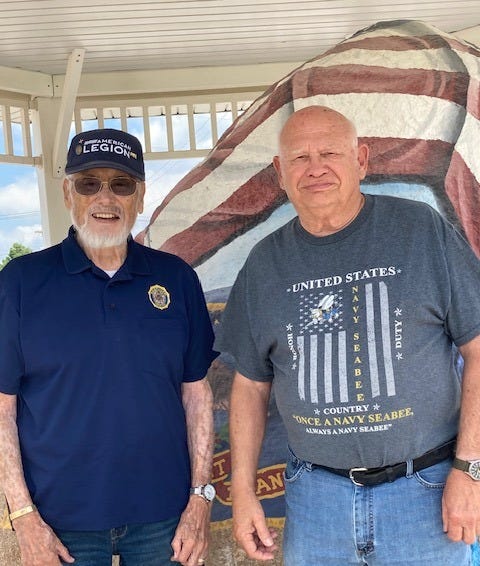
Cresco-area veterans Ed Fontes, 92, left, and James Perry with the Howard County Freedom Rock (Pat Kinney photo).
CRESCO — Five Navy admirals, a Medal of Honor recipient who escaped the Germans in World War I and an Army nurse who flew wounded out of North Africa and Italy in World War II are a lot of heroes to pack in one place.
Yet they’re all from the Cresco area and all emblazoned on Howard County’s Freedom Rock.
I was in Cresco recently — 10 miles south of the Iowa-Minnesota state line, halfway between Waterloo and Rochester, Minn., — doing oral history interviews for the Grout Museum District and the Sullivan Brothers Iowa Veterans Museum, as part of the Dr. Robert Neymeyer Voices of Iowa Oral History Archive.
I got more than I bargained for.
As part of my visit, local vets Ed Fontes, 92, a former Cresco mayor and Army veteran of the 1950s and 1960s, and James Perry, who served in the Navy Seabees and Reserves in the 1970s and ‘80s, who are both active in the town’s American Legion post, took me to see the Howard County Freedom Rock.
It bears the likenesses of five Navy admirals, all from Howard County, as well as commemorating a local Civil War regiment; trailblazing pilot, flight attendant and World War II nurse Ellen Church and World War I Medal of Honor recipient Edouard Izac.
The rock was dedicated in June 2018 and The Oak Ridge Boys, in town for the Howard County fair, sang The Star-Spangled Banner at the dedication.
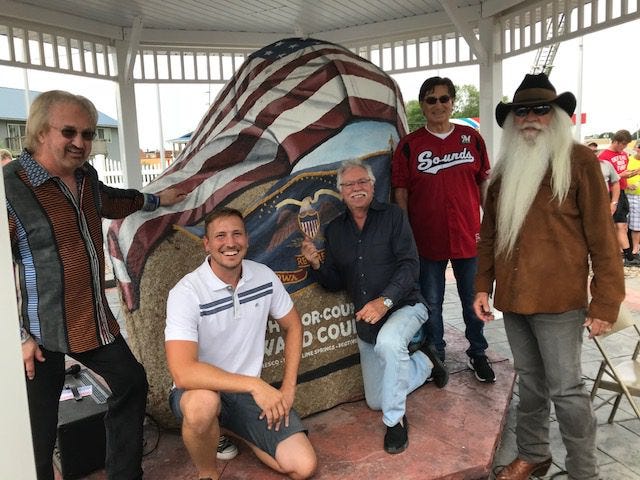
Freedom Rock artist Ray Michael “Bubba” Sorensen II, kneeling in white shirt, posed with the Oak Ridge Boys at the Howard County Freedom Rock dedication in June 2018 (Photo courtesy Howard County Business & Industry)
The Freedom Rock is the work of artist Ray Michael Sorensen II (“Bubba”) of Greenfield, who did one for each of Iowa’s 99 counties; the original one is on Iowa Highway 25 just 1.5 miles south of Interstate 80 near Menlo, 12 miles north of Greenfield in Adair County southwest Iowa.
All the rocks bear an American flag and Sorensen added symbols of local military service based on suggestions from residents of the various counties. The surrounding park the Howard County rock is located in — right along Iowa Highway 9 in downtown Cresco — was supported by numerous local individuals, organizations and businesses. Howard County’s rock is the only one sheltered inside a gazebo, according to promotional information.
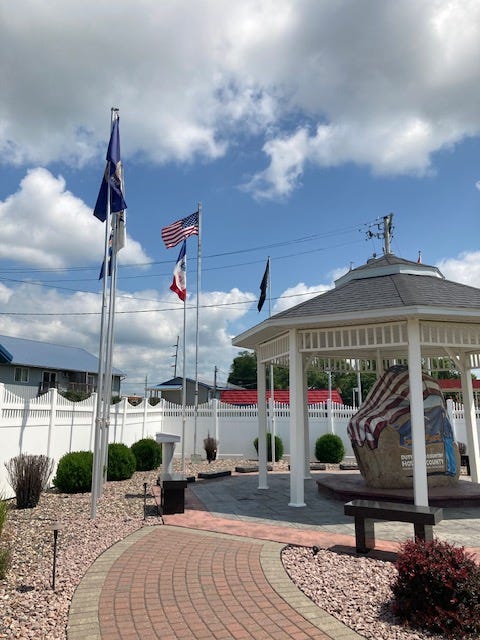
A view of the gazebo and walkway where the Howard County Freedom rock in Cresco is located The U.S. Iowa, POW-MIA and service flags of the various military branches are on site (Pat Kinney photo)
The front of the Howard County rock in Cresco commemorates the 38th Regiment of Iowa Volunteer Infantry in the Civil War. According to military and historical accounts, the regiment participated in the 1863 siege of Vicksburg, Miss. and battles at Brownsville, Texas in late 1863 and the siege of Fort Morgan as part of the Battle of Mobile Bay in Alabama in August 1864.
More than 300 of the regiment’s 1,000 soldiers died of various diseases rather than battle wounds, earning its nickname as Iowa’s “Martyr Regiment.”
The 38th’s regimental flag, sewn by women of Howard County, is preserved at the Howard County Historical Museum in Cresco.
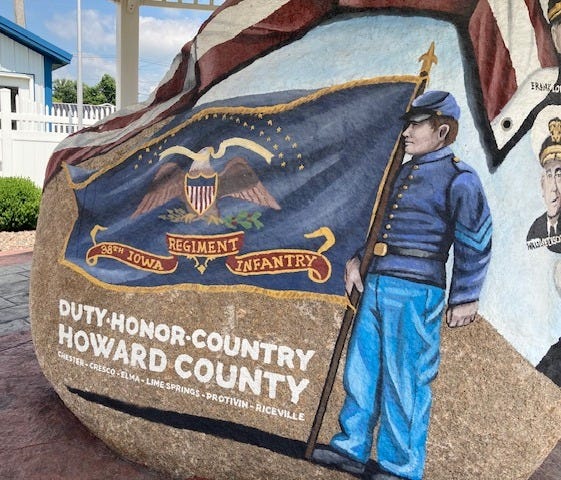
The front of the Howard County Freedom Rock honors the 38th Iowa Infantry, the “Martyr Regiment” which lost a third of its members to disease (Pat Kinney photo)
In the middle of the farm fields of landlocked Iowa, Cresco also produced five decorated Navy admirals, all featured on another side of the rock. They are Vice Admiral Frank L. Lowry, and Rear Admirals Arthur T. Moen, George Peckham, Michael J. Malanaphy and Wallis F. Peterson.
According to military and historical accounts, all five had long careers and each distinguished themselves in their service during World War II.
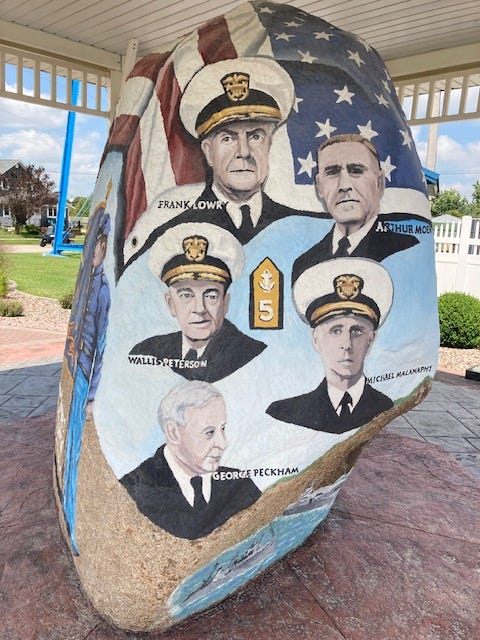
Five U.S Navy admirals, all from Cresco, are depicted on one side of the Howard County Freedom Rock (Pat Kinney photo)
Frank L. Lowry was a 1911 graduate of the United States Naval Academy at Annapolis Md. He served on submarines during World War I. During World War II, he commanded the cruiser USS Minneapolis at the Battle of Coral Sea, rescuing more than 850 crew members of the aircraft carrier USS Lexington, for which he was awarded the Navy Cross. He also commanded the Minneapolis at the Battle of Midway.
In the European theater of the war, he commanded the VIII Amphibious Force in the landings at Anzio in Italy and southern France in 1944. In between his service in the Pacific and Atlantic he commanded the Great Lakes Naval Training Station at Great Lakes, Ill. near Chicago. He also received the Legion of Merit and the Distinguished Service Medal.
Arthur T. Moen graduated from Cresco High School in 1912 and from the Naval Academy in 1917. During World War II he commanded over 300 amphibious ships and landed vessels in North Africa and Asia, serving mainly from the attack transport ship USS George A. Clymer. He was responsible for transporting more than 300,000 troops without the loss of a ship and was awarded the Legion of Merit.
Geiorge Peckham graduated from Cresco High School in 1926 and from the Naval Academy in 1931. Admiral Peckham commanded destroyers and played a major role in the battle of the Komandorski Islands near the Aleutians off Alaska in 1943, for which he received the Silver Star. Later that year he also commanded the destroyer USS Selfridge and combined with three other destroyers to sink three enemy ships in a battle with a larger Japanese force off Vella Lavella in the Solomons — and returned his heavily damaged ship to the U.S. For that service on the Selfridge, he merited another Silver Star. He also served in European theater and Philippines.
Michael J. Malanapy, a 1917 graduate of Cresco High School and a 1922 graduate of Annapolis, commanded the Navy flotilla of landing craft participating in the Battle of Iwo Jima in February and March of 1945, for which he received the Navy Cross. He also commanded the landing craft flotilla in Pacific battles at Kwajalein, Eniwetok, Saipan, Guam, Peleliu, and Okinawa. Prior to that he commanded the USS West Point, an ocean liner that had been converted into a troop transport. Malanapy also served during the Korean War. He returned to Cresco after retirement from the Navy, passing away in 1990.
Wallis F. Peterson was born in Council Bluffs but graduated from Cresco High School in 1918. He attended the University of Iowa for a year before entering the United States Naval Academy, where he graduated in 1924 and was commissioned as an ensign. He commanded several destroyers in the years between the world wars.
In World War II, according to an obituary in the Washington Post, he commanded the destroyer USS Mustin and received the Navy Cross for heroism during the Battle of the Santa Cruz Islands in October 1942, in which the Mustin defended and rescued 337 sailors from the heavily battle damaged aircraft carrier USS Hornet prior to its scuttling and sinking. The cruiser USS Juneau on which Waterloo’s five Sullvan brothers served also participated in that battle.
Peterson then commanded a destroyer squadron and led amphibious and fire support forces in the Battle of Saipan. He received the Bronze Star and the Legion of Merit with a “V” for valor in combat. He held several commands in the 1950s including naval sea transport operations based in Tokyo. at the NATO defense college in Paris and an amphibious group of the U.S. Atlantic Fleet. He retired in 1963.
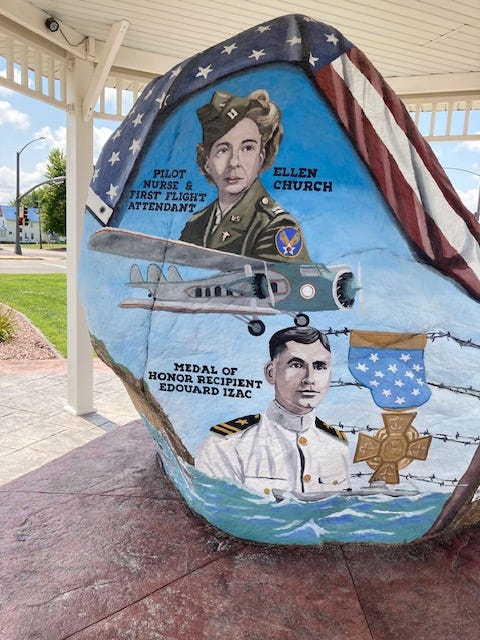
World War II nurse and trailblazing woman aviator Ellen Church and World War I Medal of Honor recipient Edouard Izac are featured on the Howard County Freedom Rock in Cresco, (Pat Kinney photo)
The Howard County Freedom Rock’s other two well-chronicled honorees include a nurse who broke new ground in the air evacuation of wounded troops and a sailor with an incredible record of endurance and survival.
Ellen Church, born in Cresco in 1904, graduated from Cresco High School and received a nursing degree from the University of Minnesota. She also learned to fly. She was a registered nurse in a hospital in San Francisco and a pilot. She approached the head of the San Francisco office of Boeing Air Transport, the forerunner of United Airlines, about being a commercial pilot.
Women were barred from those jobs at the time and she was turned down. But she convinced the airline of the merits of having nurses on airliners and in 1930 she became the first woman flight attendant on a commercial aircraft. She was named “head stewardess” and she also recruited other women to those posts. They were known as “sky girls.”
After an auto accident injury ended her career with the airline, she obtained a nursing education degree from the University Minnesota and was a nursing supervisor in pediatrics at Milwaukee County Hospital in Milwaukee.
She became a captain in the Army Nurse Corps during World War II and received the Air Medal for her work as a nurse in the U.S. Army Air Force. She helped evacuate combat-wounded American soldiers from North Africa and Italy by air and trained nurses for the air evacuation of wounded for the D-Day invasion of Normandy in 1944,
After her military service, she worked in a supervisory position at an Indiana hospital and died in a horse riding accident at age 60 in 1965. Cresco’s airport is named Ellen Church Field in her honor.
Cresco native Edouard Izac was the son and grandson of German immigrants. He attended the School of the Assumption in Cresco before his family moved to South St. Paul, Minn. where he graduated from high school. He enlisted in the Navy and graduated from the U.S. Naval Academy in 1915.
He was an officer on the troop transport ship USS President Lincoln when it was torpedoed and sunk by the German submarine U-90 on May 23, 1918 on a return trip in a convoy to New York City after dropping off troops in France. Most of the crew of 700 survived and took to lifeboats but Izac, wearing officer’s insignia, was pulled off a lifeboat by the German U-boat crew and taken as a prisoner of war.
With escape impossible, he was given open access to the ship. Unbeknownst to his captors, he was fluent in German because of his ancestry. He eventually ended up in a prison camp in southwestern Germany, having been beaten following one attempt to escape by jumping off a train. injuring himself in the jump. He lost 30 pounds in captivity, including two weeks of solitary confinement.
On the evening of Oct. 6, 1918, he and other American prisoners at the camp attempted a daring mass escape and he successfully made it to neutral Switzerland, crawling undetected past German troops at one point. They traveled 120 miles on foot through the Black Forest, following a rail line and surviving on raw vegetables, ultimately making their way to the American Embassy in Bern by Oct. 15.
He was awarded the Medal of Honor by Assistant Secretary of the Navy Franklin D. Roosevelt on Nov, 11, 1920 and would go on to serve five terms in Congress as a U.S. representative from California.
He had been the last living World War I Medal of Honor recipient when he died in 1990.
While the Howard County Freedom Rock is an attention getter, a small statue on the Howard County Courthouse grounds in Cresco tells a poignant story.
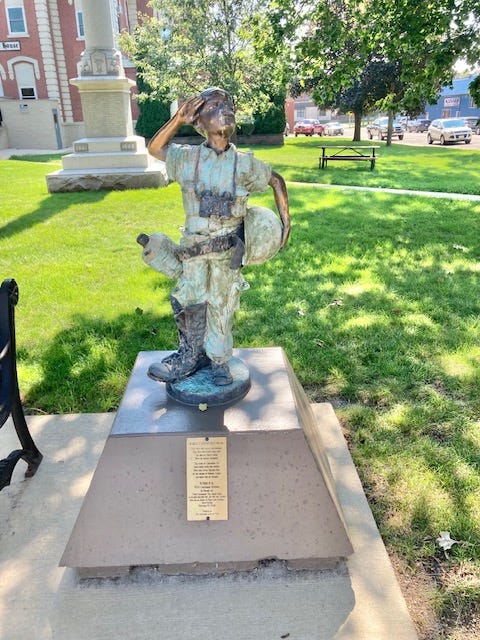
The Little Soldier Statue on the Howard County Courthouse grounds in Cresco (Pat Kinney photo)
It’s “The Little Soldier Boy Statue,” depicting a little boy dressing up in his veteran father’s Army clothes and gear. It was dedicated by the Crestwood High School Class of 1961 on their 50th anniversary reunion in 2011 in honor of their classmate Ted Rule, killed in Vietnam in 1968.
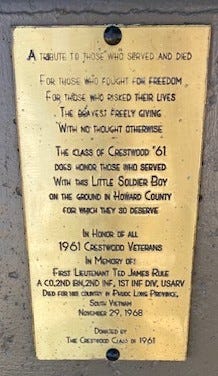
He was born in Marshalltown and the family lived in Waterloo for a time before moving to Lime Springs near Cresco, where Rule attended high school.
He attended Iowa State University, enrolled in ROTC, attended Ranger school at Fort Benning, Ga. and was commissioned as a second lieutenant and an infantry commander with A Company, 2nd Battalion, 2nd Infantry Regiment, 1st Infantry Division — known as “The Big Red One” for its shoulder patch.
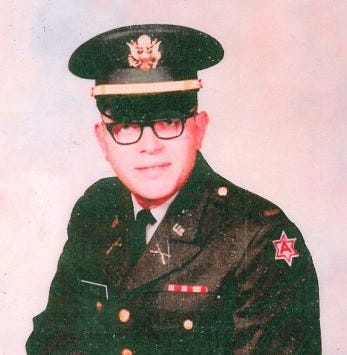
U.S. Army 2nd Lt. Ted Rule (Grout Museum District/Iowa State University)
He was killed Nov. 7, 1968 near Loc Ninh, Bien Loc Province in South Vietnam, about 60 miles north of Saigon near the Cambodian border, in an assault on an enemy base camp. He dismounted an armored personnel carrier, destroyed an enemy bunker with several grenades, then mounted the personnel carrier to assault a second bunker when he was killed.
He was posthumously awarded the Bronze Star, the Army Commendation Medal, the Purple Heart and the Silver Star for gallantry in action. His name also is engraved at Gold Star Hall in Memorial Union at Iowa State University.
Howard County’s total population is less than 10,000 and Cresco’s is less than 4,000. But the county’s and city’s native sons and daughters have loomed large in service to the country across the generations.
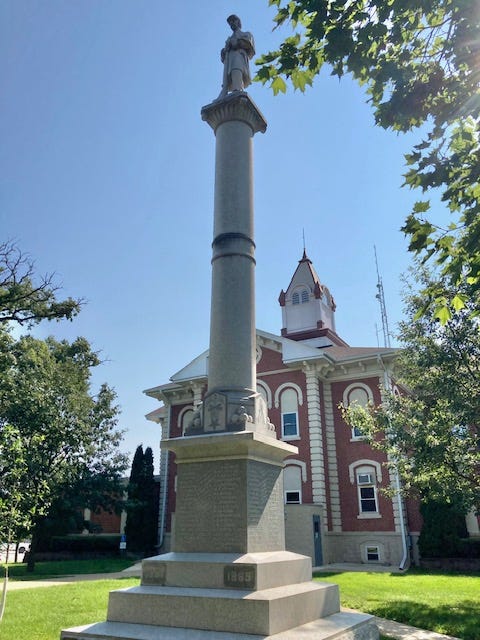
The Howard County Civil War Memorial and Courthouse in Cresco (Pat Kinney photo)?